

Introduction
Having the necessary tools as a handyman is essential to getting the task done correctly. The proper tools can make the process easier, more efficient, and more accurate, whereas the incorrect instruments can make the job more difficult and irritating. For example, using a Phillips screwdriver to try to loosen a flathead screw can shred the head and make removal much more difficult. On the other hand, having the proper screwdriver for the job can make it much easier to loosen and remove the screw. Furthermore, having the proper tools can help to protect the safety of the handyman and anybody else involved in the process. Utilizing the wrong tool, or using a tool incorrectly, can lead to an increase in the risk of injury or accidents.
For various reasons, having the correct tools is vital for handyman work:
- Efficiency: By making jobs easier and faster to perform, the correct tools can help you complete them more efficiently. Using a cordless drill with a chuck that holds screwdriver bits, for example, can help you drive screws faster and with less effort than a manual screwdriver.
- Quality: Having the correct equipment might help you accomplish greater results by giving you the accuracy and control you require. For example, a level can assist you in ensuring that your work is level and straight, but a handsaw with a fine-toothed blade can assist you in making precise cuts.
- Safety: The correct tools can assist you in working safely by lowering the chance of accidents and injuries. Using a ladder with a strong, stable base, for example, can help you avoid falls while having protective eyewear can help you avoid eye injuries.
- Versatility: The correct tools can help you accomplish a variety of tasks by giving you the necessary versatility. For example, having a multi-purpose ladder that can be used in many configurations can assist you in reaching various heights and angles, while having a variety of saws can assist you in making various types of cuts.
In this post, we’ll go through a variety of tools that every handyman needs. This will include the following:
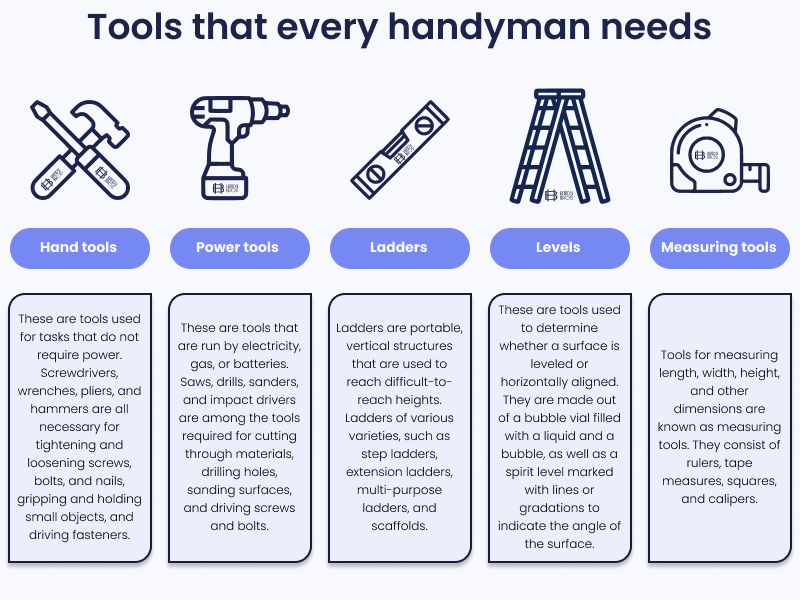
These items are necessary for a variety of handyman chores, such as home repairs, renovations, and basic maintenance. A well-stocked toolbox with a variety of sizes and types of equipment to fulfill the individual needs of each project is essential. It is also critical to use these tools properly and correctly by following the manufacturer’s instructions and taking the necessary safeguards.
Hand tools
Screwdrivers:
These are hand tools used to tighten and loosen screws. They have a handle and a shaft with a point that fits into the screw head. Screwdrivers are classified into three types:
 Phillips screwdrivers have a cross-shaped tip that fits into Phillips screws, which also have a cross-shaped indentation in the head. They are often utilized for jobs such as furniture and appliance assembly.
- Flathead screwdrivers have a flat, rectangular tip that fits into flathead screws that have a flat indentation in the head. They are widely used for jobs such as toy and electronics repair.
- Square drive screwdrivers feature a square-shaped tip that fits into square drive screws that have a square-shaped depression in the head. They are widely utilized for activities such as cabinet and fixture installation.

 Flathead
It is critical to select a screwdriver with a comfortable handle and a tip that is appropriate for the screws you will be dealing with. It’s also a good idea to have a set of screwdrivers in various sizes and types to meet the needs of any project.
Wrenches:
These are hand tools used to tighten and loosen bolts and nuts. They have a handle on one end and a head with jaws that fit around the bolt or nut on the other. Wrenches are classified into two types:

- An open-ended wrench features jaws on one end that are open, allowing it to fit around different-sized bolts or nuts. It is often used for jobs such as furniture and appliance assembly, as well as loosening and tightening bolts and nuts in confined locations.

 An adjustable wrench features jaws that may be adjusted to fit around various sizes of bolts or nuts. It is widely used for activities like plumbing and automobile repair, as well as loosening and tightening difficult-to-reach bolts and nuts.

It is vital to choose a wrench with a comfortable grip and jaws that are compatible with the bolts and nuts you will be dealing with. It’s also a good idea to have a set of wrenches in various sizes to meet the needs of any project.
Pliers:
Are hand tools for grabbing and holding small objects, as well as bending and cutting wire. They have a handle as well as a head with jaws that can open and close to grasp or hold objects. Pliers are classified into two types:

- Standard pliers have flat and parallel jaws and are used for tasks such as grabbing and holding small objects, as well as bending and straightening wire. They are frequently used for electrical work, jewelry making, and crafts.

- Needle-nose pliers feature tiny and pointed jaws and are used for tasks such as reaching into tight spaces and manipulating small things. They are frequently used for electrical work, jewelry making, and crafts.
It is vital to choose pliers with comfortable handles and jaws that are suited for the objects you will be working with. A set of pliers with a firm grip and robust jaws is also useful for handling and managing small items.
Hammers:
Are necessary for driving nails and other fasteners. There are various sorts of hammers, each with its purpose:

- Claw hammer: The claw hammer is the most commonly used type of hammer for general nailing. It has a claw on one end for nail removal and a flat head on the other for nail driving.

- A ball peen hammer is a hammer with a rounded head on one end and a pointy head on the other. It is used for metal shaping and forming, as well as general nailing.

- Brick hammer: A brick hammer has a small, flat head on one end and a chisel-shaped head on the other end. It is used for breaking and shaping bricks and concrete.

- Dead blow hammer: A dead blow hammer has a solid head filled with lead or sand, which helps to reduce rebound when striking a surface. It is used for driving fasteners into hard materials without damaging them.
It’s important to choose a hammer with a comfortable handle and a balanced weight to make it easier to drive nails and other fasteners. It’s also a good idea to have a variety of hammers in your toolkit to match the specific needs of each project.
Power tools
Saw:
Saws can be used to cut through wood, metal, and other materials. There are various varieties of saws, each with its purpose:

- A handsaw is a type of manual saw with a long, narrow blade and a handle. It can be used to cut wood, metal, and plastic. Crosscut saws, rip saws, and dovetail saws are all different varieties of handsaws, each built for a distinct style of cut.

- A circular saw is a power saw that has a circular blade and a motor. It is used to cut wood, metal, and plastic, and it is very useful for straight cuts.

- Jigsaws are power saws with a narrow blade and a motor. It’s used to carve curves and complicated shapes out of wood, metal, and plastic.

- A band saw is a power saw that has a continuous loop of blades and a motor. It’s used to carve curves and complicated shapes out of wood, metal, and plastic.
It’s critical to have a selection of saws in your toolbox to meet the unique requirements of each project. For example, a handsaw can be used to make accurate cuts in tiny locations, while a circular saw can be used to make swift, straight cuts through big amounts of wood.
Drill:
Drills are power tools used to make holes and drive screws. Drills are classified into numerous sorts, each with its purpose:

- A corded drill is a power drill that is connected to an electrical outlet. It is more powerful than a cordless drill and is best suited for heavy-duty drilling and fastening jobs.

- A cordless drill is a type of power drill that is driven by a rechargeable battery. It is less powerful than a corded drill and more portable, but it may not be as durable for long periods of use.

- A hammer drill is a type of power drill used for drilling into hard materials such as concrete and brick. It drills with a hammering action that helps to break up the material.
It is critical to select a drill with the appropriate power and torque for the operation, as well as a range of drill bits to fit the type and size of the holes to be drilled. It’s also a good idea to have a corded and cordless drill in your toolbox to meet the needs of any project.
Sander:
Sanders are power instruments used to remove roughness, flaws, and paint from wood, metal, and other materials. There are various varieties of sanders, each with its purpose:

- An orbital sander is a type of power sander that has a square or rectangular pad that vibrates in an orbital motion. It is used to sand wood, metal, and plastic, and it is very effective at smoothing uneven surfaces and removing paint.

- A belt sander is a power sander that has a continuous loop of sandpaper and a motor. It is used for sanding wood, metal, and plastic, and it is especially excellent for efficiently removing huge volumes of material.

- Detail sanders are small, handheld power sanders with a triangle pad. It is used to sand small, complicated surfaces and corners, and it is especially effective for sanding in compact places.
It’s critical to choose a sander with the appropriate power and sanding speed for the job, as well as a range of grits to match the type and quality of the material you’ll be sanding. It’s also a good idea to keep a range of sanders in your toolbox to meet the unique requirements of each project.
Impact driver:

An impact driver is a power tool used to drive screws and bolts into wood, metal, and other materials. It contains a chuck that holds screwdriver bits and a motor that generates high torque and spin to turn the bit.
Impact drivers are very beneficial for driving lengthy screws or screws into hard materials because the high torque and rotation aid to reduce the amount of force required to turn the screw. They are also excellent for removing stuck screws because the high torque might help to remove the screw.
There are corded and cordless impact drivers available. Corded impact drivers are more powerful, but their range is limited by the length of the cord. Cordless impact drivers are more portable, but they may not have as much power or stamina for longer use.
It’s critical to select an impact driver with the appropriate power and torque for the job, as well as a range of screwdriver bits to match the type and size of the screws you’ll be driving. It’s also a good idea to have both a corded and cordless impact driver in your toolbox to meet the needs of any project.
Oscillating multi-tool:
An oscillating multi-tool is a power tool that cuts, sands, and scrapes a variety of materials by using a quick back-and-forth motion, or oscillation. It is a multipurpose instrument that may be used to cut through wood, metal, and plastic, as well as sand surfaces, and remove grout or other materials.

Oscillating multi-tools come with a range of attachments, or blades, that may be swapped out to meet the needs of each activity. Some examples of common attachments are:
- Blades are used to cut through wood, metal, and plastic. Straight blades, curved blades, and scrapers are all different sorts of blades suited for different materials and applications.
- Sanding pads: Sanding pads are used to remove paint, finish, or other materials from surfaces. They are available in a variety of grits, or textures, to meet the precise requirements of each activity.
- Grout removal tools: These are used to scrape and remove grout from between tiles. They are available in a range of forms and sizes to meet the precise requirements of each task.
Oscillating multi-tools are beneficial to handymen since they are versatile and can save time and effort over utilizing many specialized tools. To ensure safety and proper performance, buy a high-quality oscillating multi-tool and operate it according to the manufacturer’s recommendations.
Reciprocating saw:
A reciprocating saw, also known as a “sawzall,” is a power tool that is used for cutting through a variety of materials. It has a long, narrow blade that moves back and forth rapidly, allowing it to cut through wood, metal, plastic and other materials with ease.

There are several types of reciprocating saws available, including corded and cordless models. Corded saws are powered by an electrical outlet and are generally more powerful and efficient, but they are limited by the length of the cord. Cordless saws are powered by a battery and are more portable, but they may not have as much power or run time as corded saws.
Reciprocating saws are commonly used in construction, demolition, and remodeling projects, as they are versatile and can cut through a variety of materials quickly and efficiently. They are also commonly used for cutting tree limbs and branches, as well as for cutting pipes and other materials in plumbing and HVAC work.
There are many different types of blades available for reciprocating saws, each designed for specific materials and cutting applications. Some common blade types include wood-cutting blades, metal-cutting blades, and demolition blades. It is important to use the correct blade for the material being cut to ensure efficient and safe operation of the saw.
Specialized tools
Ladder:
A ladder is a portable, vertical construction used for reaching difficult-to-reach heights. There are various sorts of ladders, each with its purpose:

- A step ladder is a type of ladder that has flat steps and a hinged design that allows it to be folded for storage. It is used to attain heights of up to 12 feet.

- An extension ladder is a ladder that has two or more parts that can be extended to reach greater heights. It is used to attain heights of up to 40 feet.

- A scaffold is a temporary framework used for operating at great heights. It is made up of a platform that is supported by poles or frames and is used for chores like painting, mending, and cleaning.
It is critical to select a ladder that is appropriate for the activity at hand as well as the height at which you will be operating. It’s also critical operating ladders safely, which includes following the manufacturer’s instructions and taking safeguards like utilizing a ladder stabilizer and having someone keep the ladder firmly.
Levels:
A level is an instrument used to determine whether or not a surface is level or horizontally aligned. It consists of a bubble vial filled with liquid and a bubble and a spirit level marked with lines or gradations to indicate the surface angle.
There are numerous types of levels, each with its purpose:

- A line level is a compact cylindrical level that is connected to a string or cord. It’s used to see if a surface is leveled over a long distance, like when putting up a fence or railing.

- I-beam level: An I-beam level is a larger level with a longer body and shorter end that is formed like an I-beam. It’s used to see if a surface is leveled across a longer distance, like when putting up a wall or a ceiling.

- A digital level is outfitted with electrical sensors and a display screen. It is used with more accuracy and precision to determine if a surface is leveled.

- A laser level projects a laser beam for precise measurement and alignment in construction and other fields. It can create a horizontal or vertical plane and some models have multiple lines or dots for added precision. It is portable and easy to use.
It is critical to select a level that is appropriate for the task at hand as well as the distance you will be working with. It’s also critical to operate a level correctly, which includes aligning the bubble vial with the spirit level and collecting precise readings.
Measuring tools:
Measuring tools are used to measure length, width, height, and other measurements. There are various sorts of measuring tools, each with its purpose:

- A ruler is a flat, rectangular tool with distinct gradations used to measure length and width. It is usually composed of metal, wood, or plastic and comes in a variety of sizes and units of measurement.

- A tape measure is a flexible, retractable tool with indicated gradations used to measure length and width. It is normally composed of metal or fiberglass and comes in a variety of sizes and measuring units.

- A square is a tool that has a straight angle and indicated gradations and is used to measure angles and make precise cuts. It is normally composed of metal or wood and comes in a variety of sizes and shapes.

- Caliper: A caliper is a tool that has jaws or moving arms for measuring the thickness or diameter of tiny items. It is commonly made of metal or plastic and comes in various sizes and varieties, including digital calipers.

- A laser distance measure is a tool that uses a laser beam to accurately measure the distance between two points. It is often used in construction, engineering, and other fields where precise measurements are necessary. It is compact and portable, and some models have additional features like calculating area and volume.
It’s important to have a variety of measurement tools in your toolbox to meet the unique requirements of each project. It is also critical to use measuring tools accurately, which includes following the manufacturer’s instructions and getting precise measurements.
Conclusion
The following is a list of the essential tools for the handyman:
- Screwdrivers
- Wrenches
- Pliers
- Hammer
- Saws
- Drill
- Sander
- Impact driver
- Ladder
- Level
- Measuring tools
These items are necessary for a variety of handyman chores, such as home repairs, renovations, and basic maintenance. A well-stocked toolbox with a variety of sizes and types of equipment to fulfill the individual needs of each project is essential. Using these tools properly and correctly is also critical by following the manufacturer’s instructions and taking the necessary safeguards.
Here are some suggestions for building and keeping a well-stocked toolbox:
- Invest in high-quality instruments that are long-lasting, dependable, and comfortable to use. Cheap tools may save you money in the short term, but they may break easily or be uncomfortable to use, making your work more complex and time-consuming.
- Select the appropriate tools for the job: Choose instruments that are appropriate for the tasks at hand. For example, if you plan to deal with wood, you’ll need a set of woodworking-specific screwdrivers, wrenches, pliers, hammers, saws, and drills.
- Have a variety of sizes and types: Make sure you have a variety of tool sizes and types to meet the unique needs of each project. For example, for electronics repair, you might require a set of small screwdrivers and a set of large wrenches.
- Maintain your tool organization: Keep your tools organized and easily accessible so that you can quickly find what you need. To store and transport your equipment, consider utilizing a tool chest, toolbox, or tool bag.
- Maintain your equipment: To keep your tools in good operating order, clean, lube, and sharpen them regularly. This will help to increase their lifespan and performance.
By following these guidelines, you may create and keep a well-stocked toolbox that will serve you well for a variety of handyman activities.